Training for the Barcelona Marathon: An Osteopath and Parent’s Perspective
Barcelona Marathon 2025: My Training, Race Day & What I learnt
By Alex Key, Osteopath
I’ve really started to get into running over the last 3–4 years — funnily enough, this more or less coincides with me becoming a parent. Somewhere between nursery drop-offs, clinic life and trying to keep some kind of routine, running became a way to clear my head and challenge myself.
That progression eventually led me to the London Marathon last year, which, despite record temperatures in the high 20s and a dramatic collapse at the finish line, didn’t put me off. If anything, it probably made me more determined to do another one.
So by late summer, I’d signed up to the Barcelona Marathon in March, this time running with my friend Jim who had moved to Barcelona for work.
The Plan
For Barcelona, I decided to follow a similar structure to what I’d used before:
- 4–5 runs per week
- a mix of easy runs, tempo work, intervals and long runs
- and, in theory, being a bit more disciplined with strength training and nutrition
The training plan was geared towards a finish time of just under 3 hours 30, although if I’m being honest, there was a small and deeply unrealistic part of me secretly hoping for something closer to 3:15.
That optimism only really exists before marathon training actually starts — when you’ve conveniently forgotten what marathon training actually feels like.
Training for the Barcelona Marathon started at the end of October last year.
An idyllic start in Cornwall
We were away on a family holiday in North Cornwall in late October when training began, and it was the perfect place to start. There were hills everywhere, which felt useful and virtuous at the time.
I combined the first week of training with a couple of surfs in wild Cornish conditions, long beach walks, and exploring rock pools with our 3-year-old. It was an idyllic start to marathon prep.
Of course, that lasted about a week.
Then London came calling, we returned home, and the reality of trying to fit marathon training around work, family life and winter properly began.
Fitting training around real life
One of my main aims this time was to make training work around life, rather than letting it dominate it.
I didn’t want to spend every weekend disappearing for hours on end, so I tried to build the training around:
- early Sunday starts
- running home from work
- and quick runs after nursery drop-off
A lot of my weekday miles were done around Wanstead Flats, which became a bit of a regular training ground over the winter.
The challenge, as anyone training through a British winter will know, is that motivation and logistics are one thing — but weather, illness and life admin are another.
The ankle incident… two weeks in
About two weeks into training, I managed to nearly derail the whole thing.
One Friday morning before work, I was out running on the Flats while some tree surgeons were cutting branches nearby. I looked up for a split second, heard a crunch, and had managed to hit my ankle on a loose branch and roll it.
I did what most runners do and tried to run it off for about 5 seconds, before realising that was very much not happening.
Annoyingly, I couldn’t have been much further from home, so I had to limp about a mile back.
Two weeks in, and I was already having to take my own osteopathic advice:
- strap it
- calm it down
- stop trying to be a hero
- reintroduce mobility
- then build back balance and loading gradually
I held off running for around 10 days, and although I was back training by mid-November, it took another couple of weeks before it felt functional again.
Luckily, having a clinic full of osteopaths does have its perks, they really helped me recover quicker than was expected.
December: illness, busyness and trying to keep things moving
Training through December was a bit of a grind.
Life is busy enough at that time of year anyway, and trying to fit in regular mileage around clinic work, teaching, Christmas plans and general fatigue wasn’t easy. A bout of illness in mid-December cost me another week, which wasn’t ideal.
But by Christmas, things were starting to come together.
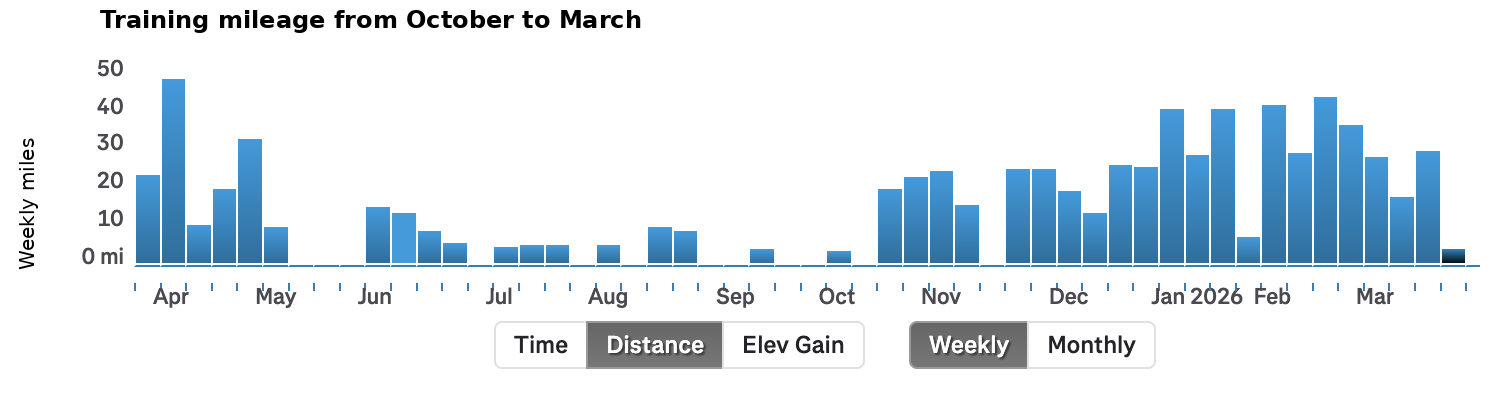
The miles were gradually building, I was averaging just over 25 miles per week, and then in the week between Christmas and New Year, I hit my first 40-mile week.
We also had some lovely news at home during that period — we found out Alice was pregnant, with our new little wrigglet due in July — so that Christmas had a bit of extra magic to it.
January and February: the real work
By the first week of January, I was already at week 11 of the plan — halfway through the full 20 weeks.
And honestly, this is where marathon training stopped being “nice idea” territory and became more of a slog.
January and February were the real working months:
- longer weekly mileage
- repeated midweek runs
- trying to hit long runs consistently
- getting out in the dark and rain when motivation wasn’t exactly overflowing
We seemed to have one of the wettest winters on record, which happened to line up nicely with some of my biggest training blocks.
A lot of those weeks sat around 35–45 miles (56–72km), and while I got most of the running done, I definitely know where I cut corners:
- I skipped too many interval sessions
- I ducked out of a few tempo efforts
- and I didn’t do as much hill work as I should have
Which, as it turns out, does matter when you’re trying to run a marathon efficiently.
I also picked up another cold or two, because winter marathon training apparently comes with a compulsory side serving of illness.
One thing that did help massively during those heavier months was support from Sandy Rowe at our clinic, who helped keep me moving with treatment, exercise advice, nutrition guidance and a bit of accountability.
Sometimes when you’re deep in a training block, just having someone to help you keep perspective is a big part of staying consistent.
f you’re interested in what the training actually looked like week to week, you can view all of my runs on Strava here:
https://www.strava.com/athlete/training
Taper week in Barcelona
Before I knew it, race week had arrived.
The three of us travelled out to Barcelona from Wednesday to Monday to stay with our friends Jim & Ruth and enjoy a few days in the city before race day on Sunday.
I’d sorted my race nutrition beforehand and stocked up on energy gels from Lou at London City Runners, and about a month before the race Lou had me on her running machine to help me pick up a fresh pair of Saucony shoes — the same model I’d been using already, with enough time to wear them in properly before race day.
In theory, race week should be about rest, hydration and sensible preparation.
In reality, doing a marathon abroad means:
- a lot of walking
- tapas everywhere
- and probably a bit too much Spanish Rioja
All lessons for next time.
The Saturday before the race was nicely on-brand with the rest of training: it rained.
Jim and I headed to the marathon expo to collect our bibs and goodie bags, very nearly coming home with new sunglasses and a Garmin watch we absolutely didn’t need, then sensibly resisted and went back to prepare properly.
That evening involved spaghetti bolognese, the final day of the Six Nations, and watching England nearly pull off a famous win in France before losing at the death — which, in hindsight, probably wasn’t the most calming pre-race viewing choice.
Sleep the night before a race is always a bit patchy anyway, and this one also involved sharing a bed with a small child, which reminded me just how much space one tiny human can somehow take up.
Race day: Barcelona Marathon
Then the big day arrived.
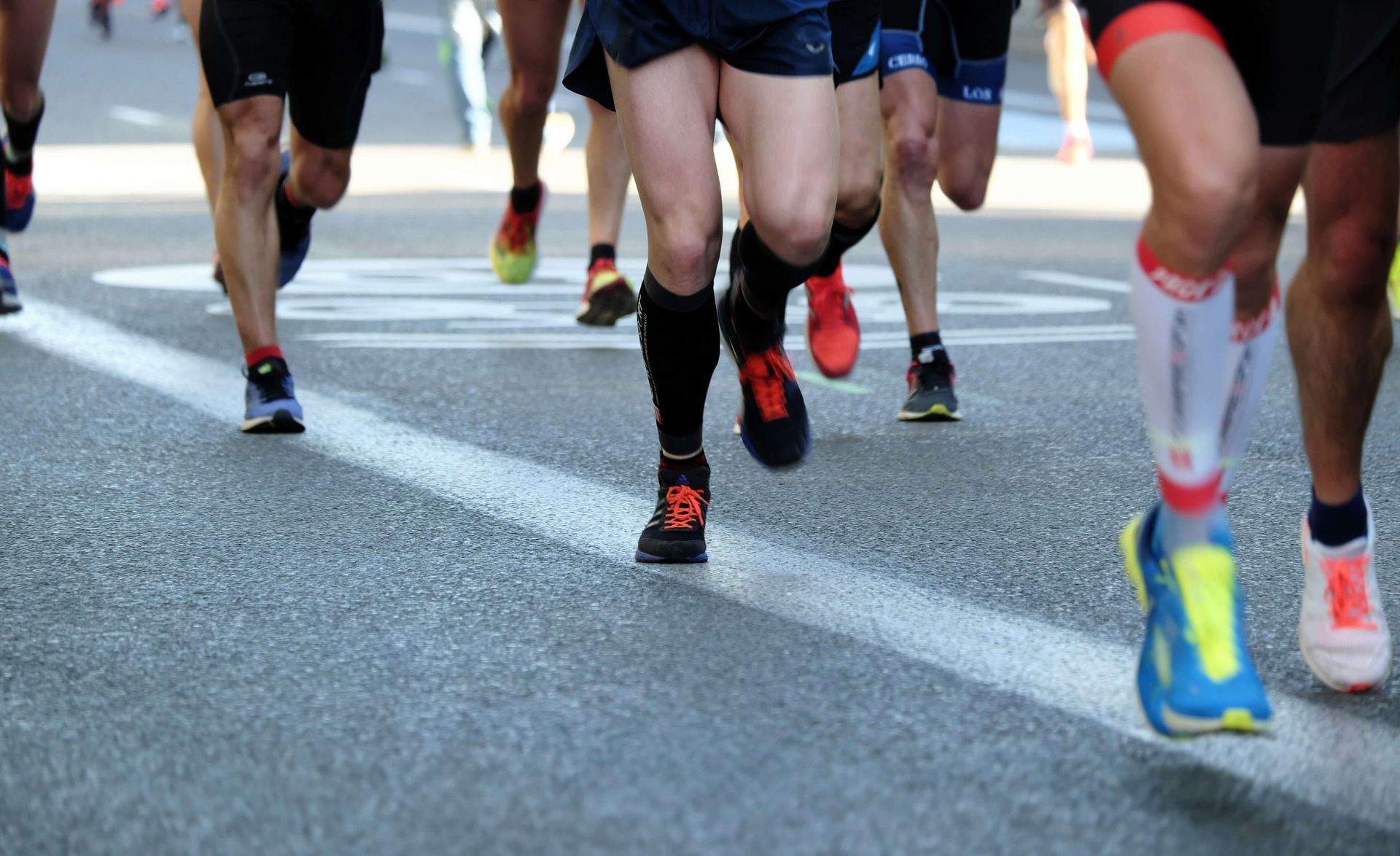
A beautiful Spanish morning, perfect running weather, and the sort of atmosphere that makes you remember why people sign up for these things in the first place.
Jim and I got out early… although perhaps not quite early enough… and after a slightly frantic build-up, made it onto the start line.
The race itself was, for the first half, pretty close to ideal.
The first half felt like a dream:
- great crowds
- city streets in the shade
- good energy
- and I managed to spot Alice and Ottilie on the route a couple of times
I felt strong, relaxed and able to actually enjoy the surroundings, which doesn’t always happen in a marathon.
What I hadn’t fully appreciated was that quite a lot of that first half had been slightly downhill as we made our way out towards the beach.
Which meant, of course, that we eventually had to go back up.
The real marathon starts later
At around mile 15–16, I could feel the legs and body starting to complain, and a few unexpected loo stops had to be fitted in…
By the time we headed back into the city, I realised I was now paying for all the nice downhill running I’d enjoyed earlier.
Then came that classic marathon thought:
“Crikey. Mile 20. Only 6.2 to go.”
Which is a completely ridiculous sentence when you think about it.
That final stretch is where the marathon becomes far more mental than physical. Your body is tired, everything hurts a bit, and you’re mostly negotiating with yourself one mile at a time.
At that point I found myself thinking about:
- Ottilie
- Alice
- Our new arrival in July
- how lucky I was to be there
- and the bigger picture of even being able to do this after the head injury I went through a few years ago
That gave the final miles a bit more perspective.
The final mile (which felt about 10 miles long)
With about half a mile to go, I could see the Sagrada Família and thought I was nearly there.
Unfortunately, the people who designed the route clearly had a cruel streak, because there was still a 35-metre incline tucked into the final mile.
At one point I thought I was almost done, only to be sent left for one final loop. It was probably only a few hundred metres, but it felt like about 10 miles.
Eventually, the actual finish line came into view.
One last push. One last sprint. One final attempt to pretend the legs still worked.
By the finish line I had an extra 500m more than the race distance.....
And then — done.
Barcelona Marathon finished in 3 hours 27 minutes.
All gels used.
Enough water consumed to fill a small lake.
Enough leg ache to fill 10 massage tables.
Accumulated a extra 500m more than race distance
The strange post-marathon feeling
Immediately after finishing, the thought is usually something along the lines of:
“Never again.”
Then about 5–10 minutes later, you start to feel vaguely human again.
And by the time I was sitting in the Spanish sunshine with an Estrella in hand, I was already wondering what the next one might be.
That said, with a newborn arriving in July, the next marathon might need to wait a little while.
What I learnt from this marathon
Every training block teaches you something, and this one definitely did.
1) Hills, hills, hills
If I’m honest, I didn’t do enough hill work this time.
I got some good early training in while we were in Cornwall, but once I was back in London for winter, I didn’t consistently build that into the plan — and I think it showed later in the race.
2) I skipped too many quality sessions
The long runs got done, which is important, but I definitely let a few too many:
- interval sessions
- tempo efforts
- and harder midweek workouts
slip by when life got busy.
That’s understandable — but also probably the main reason I ran well, rather than as well as I might have done.
3) Strength training matters
Like a lot of runners, I always know I should do more strength work.
And like a lot of runners, I didn’t quite do enough of it.
It’s one of the biggest things I’d improve next time.
4) Nutrition matters more than you think
Not just on race day — but throughout the whole block.
Eating enough, fuelling properly, and recovering well makes a bigger difference than most runners want to admit.
5) Don't forget about your head - psychology and what headspace you are in is so important in the lead up to the marathon. Some breathing exercises and meditation through the whole training plan, especially in the few weeks prior to race day is so beneficial
6) A spring marathon means winter training
And winter marathon training is, frankly, a bit grim.
There’s something to be said for targeting an autumn marathon instead — or at least something later than mid-March — so the biggest weeks don’t land right in the wettest, darkest part of the year.
Final thoughts
Marathon training is a strange thing.
At times it’s inconvenient, uncomfortable, time-consuming and mildly ridiculous. But it’s also one of the most satisfying things I’ve ever done.
Barcelona was a brilliant race, a brilliant city to run in, and another reminder that even when training isn’t perfect, consistency over time still counts for a lot.
If you’re currently training for something yourself — whether that’s a marathon, your first 5k, or just trying to get moving again — keep going.
And if your first sunny weekend of spring involves 4 hours attacking the garden with a trowel, please warm up first.
Happy running everyone,
Alex
Why foot pain spikes in autumn
Every autumn at VPO we see a sharp rise in foot pain, and the timing is no coincidence. After months in sandals, flip flops and Birkenstocks, we switch almost overnight to boots, trainers and work shoes. Add wetter ground, darker evenings and a return to routines after summer, and our feet are suddenly asked to work in a very different way.
Each foot contains 26 bones, 33 joints, around 30 muscles and tendons that act on it, and over 100 ligaments. With that many moving parts, a small change in what you wear or how you walk can shift load onto tissues that aren't used to it. This blog explains how the foot works, what happens to it with every step, and the most common places we see pain, so you can make sense of what your feet might be telling you.
[IMAGE: Autumn footwear swap – sandals vs boots/trainers]
How the foot is built
The foot is best thought of as three sections that work as a team: the rearfoot, the midfoot and the forefoot.
[IMAGE: Skeleton of the foot from above and the side, with the three regions shaded]
- The rearfoot is made up of the heel bone (calcaneus) and the talus, which sits on top of it and forms the ankle joint with the two shin bones (tibia and fibula). The joint between the talus and heel bone, the subtalar joint, lets the heel tilt inwards and outwards. This is what allows your foot to adapt to uneven ground.
- The midfoot is a cluster of five smaller bones (the navicular, cuboid and three cuneiforms) that form the arch. The key joint here, the midtarsal joint, can either loosen to absorb shock or lock to make the foot rigid.
- The forefoot includes the five long metatarsal bones and the 14 small bones of the toes. The big toe joint is particularly important, as it bends as we push off with every step.
The arches
The foot has three arches: one along the inner edge (the one most people think of), a lower one along the outer edge, and one running across the foot. They are held up by the shape of the bones, by ligaments, by a thick band of tissue under the sole called the plantar fascia, and by muscles.
Those muscles come in two groups. The long muscles start in the lower leg and send tendons down into the foot; these control the big movements and help support the arch. The small muscles live entirely within the foot and act like a fine-tuning system, keeping the arch stable and the toes working.
[IMAGE: The arches of the foot and the plantar fascia from the side]
What your foot does with every step
In a single step, your foot has two opposite jobs. First it must become soft and flexible to absorb the impact of landing and adapt to the ground. Then, a fraction of a second later, it must become a stiff lever to push you forwards. The clever part is how it switches between the two.
[IMAGE: The phases of the walking cycle – heel strike, flat foot, midstance, heel lift, toe off, swing]
- Heel strike. The outer edge of the heel touches the ground first. The muscles at the front of the shin work to lower the foot gently, rather than letting it slap down.
- Loading and flat foot. The heel bone rolls slightly inwards (pronation). This “unlocks” the midfoot joints so the arch can flatten a little, spreading the load and soaking up shock. Some pronation is completely normal and healthy.
- Midstance. Your body passes over the foot. The calf muscles start to control how far the shin moves forwards over the ankle, and the foot begins to roll back outwards.
- Heel lift. The heel rolls outwards (supination), which “locks” the midfoot joints and turns the foot into a rigid lever. At the same time, the big toe starts to bend upwards, which pulls the plantar fascia tight like a winch and raises the arch. This is known as the windlass mechanism.
- Toe off. The calf and the long toe muscles drive you forwards, with most of the push coming through the big toe.
- Swing. The foot lifts clear of the ground and the muscles at the front of the shin hold the toes up so you don't trip, ready for the next heel strike.
When this sequence works well, the load is shared across many joints and tissues. When something changes, such as a stiff big toe, a weak calf, an old ankle sprain, or a new pair of shoes, one part of the chain often ends up working harder than it should. That is usually where pain appears.
Where it hurts, and what might be involved
Where you feel pain gives us useful clues about which tissues are under strain. Below are the most common areas we see in clinic. These are general patterns, not a diagnosis, and more than one tissue is often involved.
Outer edge of the foot
- Peroneal tendons. Two tendons run behind the bony bump on the outside of the ankle and along the outer edge of the foot. They steady the foot on uneven ground, and can become irritated after an ankle sprain or with shoes that tip the foot outwards.
- The base of the fifth metatarsal. The bony bump halfway along the outer edge, where one of these tendons attaches, can become sore with repeated strain.
- Cuboid. This midfoot bone can become stiff or painful, often after a rolled ankle.
[IMAGE: Outer edge of the foot – peroneal tendons and fifth metatarsal]
Inner edge of the foot
- Tibialis posterior tendon. This tendon runs behind the bony bump on the inside of the ankle and is one of the main supports of the arch. When it is overloaded, pain and swelling can develop along the inner ankle and arch, and the arch may feel like it is dropping.
- Bunions and the big toe joint. Pain at the base of the big toe can come from a bunion or from wear and stiffness in the joint (sometimes called hallux rigidus), which makes pushing off painful.
[IMAGE: Inner edge of the foot – tibialis posterior tendon and big toe joint]
Top of the foot
- Extensor tendons. These tendons lift the toes and run across the top of the foot. Tight laces or stiff new boots pressing on them are a very common autumn culprit.
- Midfoot joints. Stiffness or irritation in the small joints across the top of the arch.
- Stress reactions in the metatarsals. A sudden increase in walking or running, especially in unfamiliar footwear, can overload these bones. Pain that is sharp, localised to one spot and worse with activity should always be checked.
[IMAGE: Top of the foot – extensor tendons and metatarsals]
Sole of the foot
- Plantar fascia. The most common cause of heel and arch pain we see. It is typically worst with the first steps in the morning or after sitting, and eases as you get moving.
- The ball of the foot. Pain under the metatarsal heads (metatarsalgia) can come from thin soles, high heels or a stiff big toe shifting load onto the smaller toes.
- Morton's neuroma. An irritated nerve between the toes, usually the third and fourth, causing burning, tingling or a feeling like walking on a pebble. Narrow shoes often make it worse.
- Heel fat pad. The cushioning pad under the heel can become bruised and sore, particularly on hard surfaces.
[IMAGE: Sole of the foot – plantar fascia, metatarsal heads and common neuroma site]
Back of the heel
- Achilles tendon. The strongest tendon in the body, connecting the calf to the heel. Pain can sit in the middle of the tendon or where it attaches to the heel bone, and often follows a change in activity or footwear.
- Bursitis. Small fluid-filled cushions around the back of the heel can become inflamed, especially when a stiff shoe heel counter rubs.
- Haglund's deformity. A bony bump on the back of the heel that is aggravated by rigid shoe backs.
[IMAGE: Back of the heel – Achilles tendon and bursae]
Ankle
- Ligaments. The ligaments on the outside of the ankle are commonly sprained when the foot rolls inwards; slippery autumn leaves and wet pavements don't help. An old sprain that never fully recovered can leave the ankle feeling weak or unstable.
- Front of the ankle. Pain or pinching at the front of the ankle when squatting or walking uphill can come from stiffness or impingement in the joint.
- Tarsal tunnel. Nerve irritation on the inside of the ankle can cause tingling or burning into the sole.
[IMAGE: Ankle ligaments from the outside and inside]
What helps, and when to see us
Most autumn foot pain settles with a few sensible changes:
- Ease into new footwear. Wear new boots or shoes for short spells at first, and alternate with a pair your feet already know.
- Check the fit. Leave room for your toes to spread, and make sure laces aren't pressing hard across the top of the foot. A heel that rubs or digs in is worth swapping out.
- Keep your feet moving. Simple exercises such as calf raises, toe spreading and rolling the sole over a ball help keep the foot strong and mobile.
- Build up gradually. If you are increasing your walking, running or sport, add a little at a time.
[IMAGE: Simple foot exercises – calf raises, toe spreading, ball rolling]
It's worth booking in if pain lasts more than a couple of weeks, is getting worse, stops you walking normally, or is sharp and focused on one spot. Please seek medical advice promptly if you have significant swelling or bruising after an injury, can't put weight on the foot, or have numbness, colour change or signs of infection.
At VPO, we'll look at the whole picture: your feet, ankles, knees, hips and the way you walk, as well as your footwear and activity. From there we'll build a plan that may include hands-on treatment, targeted exercises and advice to get you back on your feet comfortably.
[Book an appointment – link]